
Tired but wired: why your body is exhausted and your mind won't switch off
You're worn out, yet the moment you lie down your mind starts racing. That isn't a character flaw. It's a nervous system still in daytime gear. Here is what's going on, and a few small ways to shift down.
In short
Feeling exhausted yet unable to switch off at night is common when the day leaves your stress system running. A slower last hour, getting tomorrow out of your head and a calming body cue can help the evening settle.
Written by
 Libor Zezulka, M.A.Founder of Harmonized
- Verified by Harmonized
- Updated 3 November 2026
- 6 sources · 3 min read
On this page
What helps
Write down what's still open and one first step for tomorrow.
Breathe slowly for five minutes, with a long exhale.
Charge your phone outside the bedroom.
Keep the last 30 minutes low-light and screen-free.
Try it in Harmonized
The bigger picture
The problem
It's late. You've been tired since the afternoon. But now, in bed, your thoughts start again: tomorrow's list, a message you didn't answer, a conversation you replay. You pick up your phone "just for a minute". An hour later you're more awake than before.
Many people know this state. Body: done. Mind: still running.
What's happening inside
Your system is still in "on" mode. Sleep researchers describe a state of raised arousal, where the body and mind stay alert when they should be winding down. It shows up as racing thoughts, a tense body and a feeling of being "on guard" [2]. Being tired and being able to switch off are two different things.
Evening screens push the clock later. In a controlled study, reading on a light-emitting device before bed, compared with a printed book, delayed the body's evening melatonin rise, made it take longer to fall asleep and left people less alert the next morning [1]. Light is only one part of it. What we read and scroll keeps the mind busy too.
"Just five more minutes" is common. Researchers call it bedtime procrastination: going to bed later than you meant to, with nothing actually stopping you [3]. It's often the one part of the day that feels like your own, which is why it's hard to give up.
Unfinished tasks keep circling. In one experiment, people who spent five minutes writing a specific to-do list for the next days fell asleep faster than people who wrote about tasks they had already finished [6]. Getting the open loops onto paper seems to let the mind put them down.
What helps: shift gear, don't force sleep
You can't order yourself to relax. You can change the conditions, a little at a time.
- Close the day on paper. Write down what's still open and the first small step for tomorrow. Five minutes is enough [6].
- Slow your breathing for a few minutes. Slow, steady breathing is linked with a calmer body and a quieter mind [4]. In a month-long study, five minutes a day of "cyclic sighing" (a longer exhale) improved mood and lowered breathing rate more than mindfulness meditation [5].
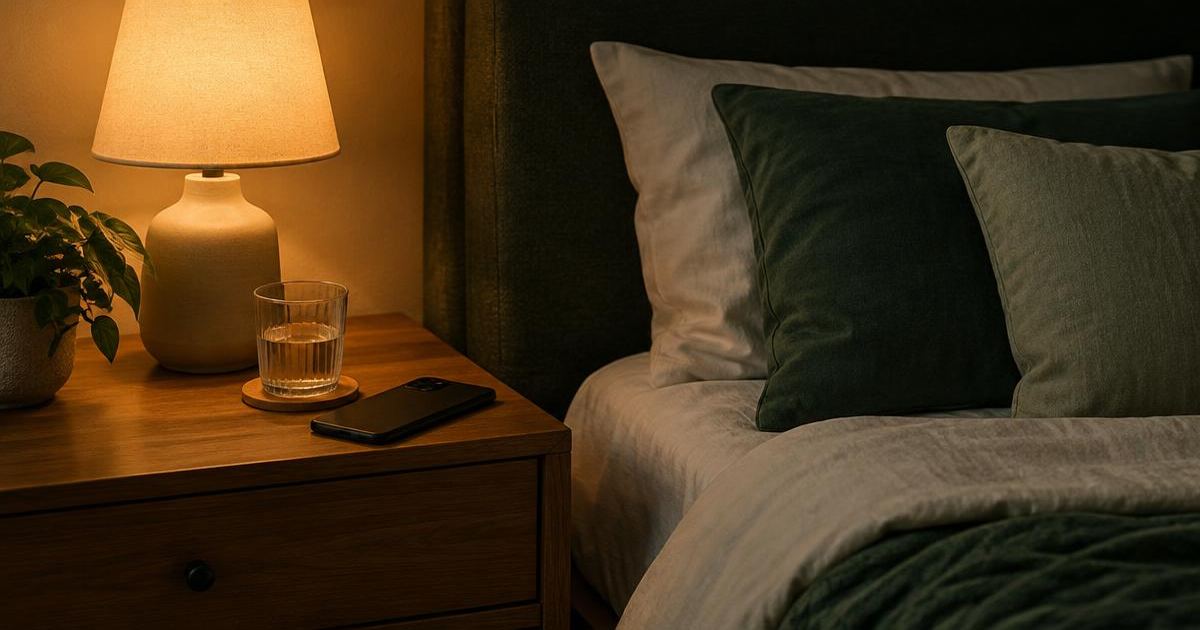
- Put the phone to bed first. Charge it outside the bedroom, or at least out of reach. Less light, fewer prompts, one less decision [1].
- Make the last 30 minutes boring on purpose. Low light, paper, a shower, stretching. The goal is to give the mind nothing new to chew on.
How Harmonized helps
Harmonized is built around this moment. The evening check-in names how your body and mind feel, so you can see the "wired" pattern instead of fighting it. Digital Sunset walks you through closing the day: what's still open, what went well and putting the phone away. A short Disconnect play gives your hands and eyes something offline to do.
When to look for more support
If you regularly can't sleep for weeks, wake up exhausted every day, or feel low or anxious most of the time, talk to your doctor or a qualified professional. Harmonized is a wellness companion, not a medical service.
Questions people ask
Why am I tired but can't sleep?
Being tired and being able to switch off are different. If your mind and body are still in an alert state, sleep is harder to reach even when you're exhausted [2].
Do screens really affect sleep?
Evening use of light-emitting devices delayed melatonin and made falling asleep slower in a controlled study [1]. What you scroll can keep your mind busy too.
When to look for more support
If sleep problems last for weeks, or you feel low or anxious most days, please talk to your doctor or a qualified professional. Harmonized is a wellness companion and doesn't diagnose or treat any condition.
Sources
- [1] Evening light-emitting screens delayed melatonin, sleep onset and next-morning alertness compared with a printed book.Strong evidence · checked 3 November 2026
- [2] Raised physical and mental arousal is a central feature of difficulty switching off at night.Strong evidence · checked 3 November 2026
- [3] Going to bed later than intended without outside reasons is a common, measurable behaviour.Moderate evidence · checked 3 November 2026
- [4] Slow breathing is linked with calmer body signals and better emotional state.Moderate evidence · checked 3 November 2026
- [5] Five minutes a day of cyclic sighing improved mood and reduced breathing rate more than mindfulness meditation.Early evidence · checked 3 November 2026
- [6] Writing a specific to-do list for five minutes before bed led to falling asleep faster.Early evidence · checked 3 November 2026
Want to notice this in your own day?
A daily check-in takes about 40 seconds. Free to start, no card.
Try the free check-inHarmonized is a wellness app, not a medical or therapy service.