
Doomscrolling: why you can't stop scrolling bad news, and how to put it down
You meant to check one thing. Twenty minutes later you feel heavier, and you're still scrolling. Here is why the feed is so hard to leave, and small ways to stop without willpower battles.
In short
Doomscrolling is the pull to keep reading worrying news or feeds long after it stops helping. Endless feeds and uncertainty keep attention hooked; a clear stopping point, a phone-free break and one real-world action help you step out.
Written by
 Libor Zezulka, M.A.Founder of Harmonized
- Verified by Harmonized
- Updated 3 November 2026
- 6 sources · 3 min read
On this page
What helps
Decide when the session ends before you open the app.
Turn on grayscale or move news apps off your home screen.
Keep social media to about 30 minutes a day for a few weeks.
Have one offline replacement ready.
Try it in Harmonized
The bigger picture
The problem
You open the app for one thing. Then one headline leads to another, then comments, then a video. You're not enjoying it. You feel tense, a little hopeless, and still you keep going. Later you wonder where the time went.
That pattern now has a name: doomscrolling.
What's happening inside
Our attention leans toward threat. Across many studies, bad news and negative events grab more attention and weigh more than good ones of the same size [2]. A feed full of worrying news is hard to look away from. That's an old survival habit, not a personal weakness.
More exposure, more stress. After the 2013 Boston Marathon bombings, people who spent many hours a day with media coverage reported more acute stress than people who were actually near the event [3]. Repeated exposure keeps the alarm going.
Doomscrolling is linked with feeling worse. Researchers who built a scale to measure doomscrolling found that people who scored higher also reported more distress and lower wellbeing [1]. The studies show a link, not proof of which comes first, but many people recognise the loop: feeling low, scrolling, feeling lower.
The feed has no natural end. There's no last page, so the decision to stop is always yours to make. Each time, you pay for it with willpower.
What helps: add friction and a clear stop
- Give the session an end before it starts. Decide "two minutes" or "this one article", then close the app.
- Make the phone less shiny. Switching to grayscale reduced daily screen time in a study with students [5]. Moving news apps off the home screen works in the same way.
- Limit, don't quit. Limiting social media to about 30 minutes a day for three weeks reduced loneliness and low mood compared with usual use [4].
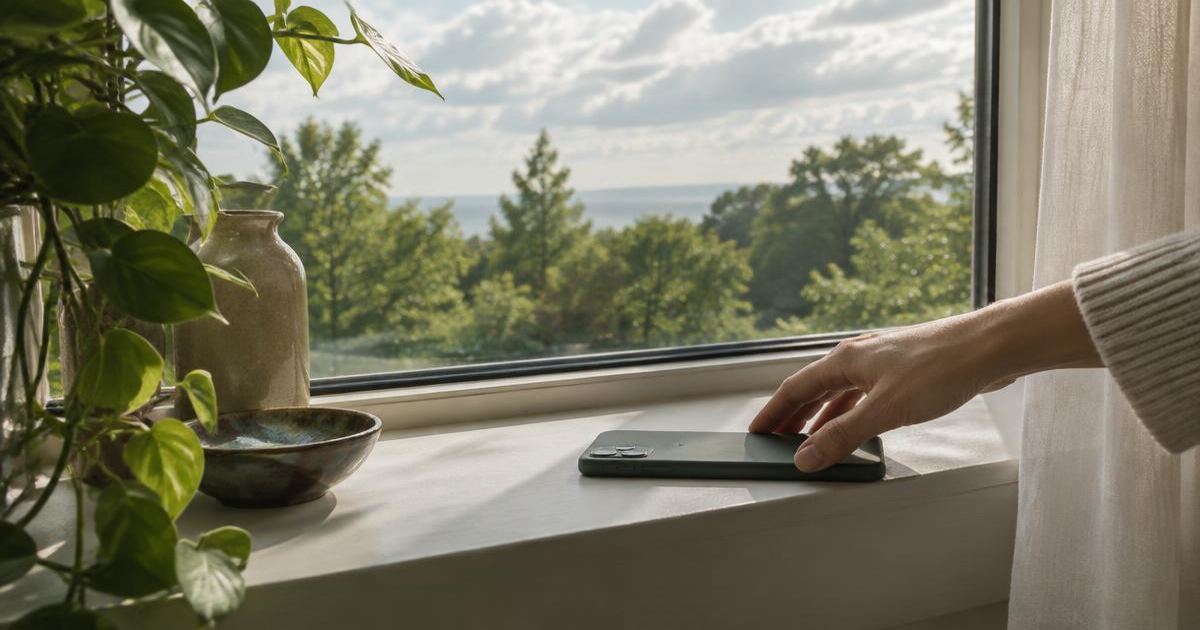
- Put distance between you and the phone. In one well-known study, simply having your phone on the desk was linked to lower working memory. Later replications are mixed, but distance remains an easy test [6].
- Replace, don't just remove. Have one offline thing ready: a walk, a page of a book, two minutes of slow breathing.
How Harmonized helps
Harmonized turns "stop scrolling" into a small, clear move. A Disconnect play gives you a short, phone-down activity with a timer, so stopping has an end point. The check-in shows how your mind feels before and after, so you can see the effect of the feed instead of guessing. A short journal note helps you notice what you were looking for when you opened the app.
When to look for more support
If news or scrolling leaves you feeling hopeless, anxious or low most days, or you can't function as you'd like, talk to someone you trust or a qualified professional. Harmonized is a wellness companion, not a medical service.
Questions people ask
Why can't I stop doomscrolling?
Attention leans toward threat [2], and feeds have no natural end, so every stop costs willpower. Adding friction and a clear end makes stopping easier.
Is doomscrolling bad for you?
When to look for more support
If news or scrolling leaves you feeling hopeless, anxious or low most days, please talk to someone you trust or a qualified professional. Harmonized is a wellness companion and doesn't diagnose or treat any condition.
Sources
- [1] People who doomscroll more report more distress and lower wellbeing (correlational).Moderate evidence · checked 3 November 2026
- [2] Negative events and information draw more attention and weigh more than positive ones.Strong evidence · checked 3 November 2026
- [3] Six or more hours a day of media coverage after the Boston bombings was linked with more acute stress than being at the event.Strong evidence · checked 3 November 2026
- [4] Limiting social media to about 30 minutes a day for three weeks reduced loneliness and low mood.Moderate evidence · checked 3 November 2026
- [5] A grayscale phone setting reduced daily screen time.Early evidence · checked 3 November 2026
- [6] The mere presence of one's phone was linked to lower available working memory; replications are mixed.Mixed evidence · checked 3 November 2026
Want to notice this in your own day?
A daily check-in takes about 40 seconds. Free to start, no card.
Try the free check-inHarmonized is a wellness app, not a medical or therapy service.